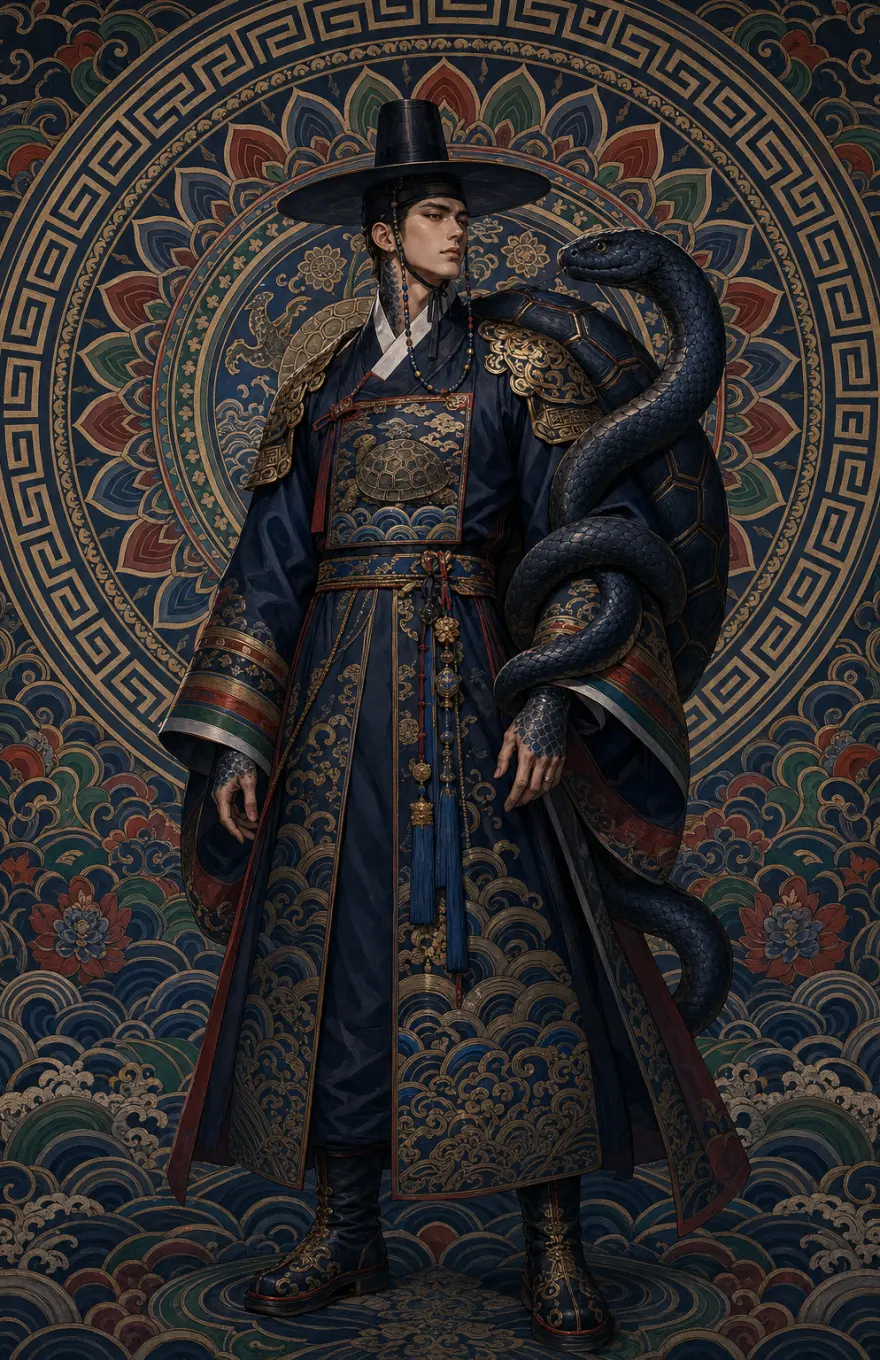
Water · 玄武 Black Tortoise
Water (水) — The Element of Wisdom & Flow
Water (水, Su) embodies the energy of rivers, rain, and the deep ocean. Carrying the stillness of winter, it represents wisdom, adaptability, storage, and introspection. In Saju, a person with dominant Water is traditionally seen as a deep thinker with exceptional flexibility.
Core Attributes
Season: Winter (冬) — the time of rest and energy conservation. Direction: North (北). Color: Black / dark blue tones. Taste: Salty. Body correspondence: Kidneys, bladder, ears, bones/marrow — in traditional Korean medicine, Water governs kidney and bladder energy (a symbolic system, not a medical claim).
Representative Stems & Branches
Heavenly Stems: Im (壬, Yang Water) — the image of a great river, the ocean, a mighty current. Gye (癸, Yin Water) — the image of dew, raindrops, a quiet brook. Earthly Branches: Hae (亥, Pig) — Yin Water, the deep waters of early winter. Ja (子, Rat) — Yang Water, the still water of midwinter midnight — the starting point of a new cycle.
Personality Keywords
Keywords traditionally linked to strong Water energy: wisdom, flexibility, adaptability, communication, intuition, depth of thought. Im Water (great river) temperament is described as grand in scope and embracing; Gye Water (dew) as perceptive and observant.
When Water Is Strong
High Water proportion is interpreted as keen intellectual curiosity, quick situational awareness, and the ability to navigate crises fluidly. Excess Water may manifest as indecisiveness or emotional depth that is hard to surface from. Water generates Wood (水生木), so strong Water naturally channels into new beginnings and growth.
When Water Is Weak
When Water is scarce, depth of thought and flexibility may be diminished, according to tradition. Metal generates Water (金生水), so Metal energy — decisiveness, clarity, structure — is viewed as the element that replenishes weak Water.
Related 25 Types
The five types with Water as the dominant element: Deep Ocean (Concentrated), Dry Well (Deficient), Twin Rivers (Twin-peak), Tidal Dance (Ripple), Still Lake (Balanced).